




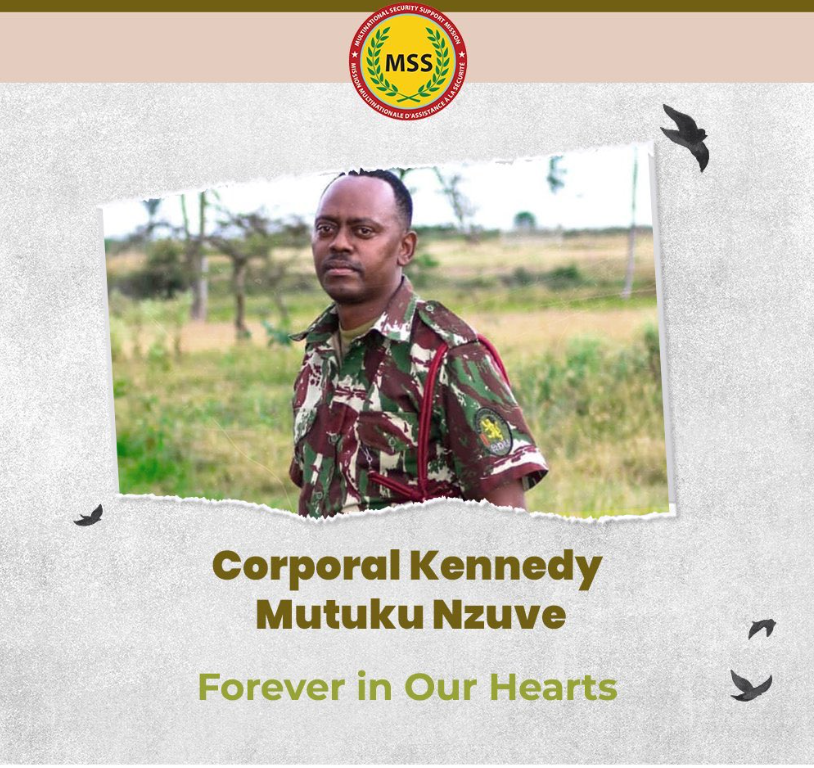
Two days before his death, Corporal Kennedy Mutuku Nzuve called his mother from Haiti. He was cheerful, hopeful, and said he had grown to love the country he was serving in. Forty-eight hours later, he was gone — a Kenyan life cut short in a foreign land.
The Facts
Nzuve, a member of the Rapid Deployment Unit, was deployed under the Multinational Security Support Mission in Haiti. On August 31, he died in an accident involving armored vehicles on the treacherous Kenscoff–Pétion-Ville road, notorious for ambushes and crashes.
Eight other officers were injured, three critically. Nzuve was rushed to Lambert Santé Hospital but was pronounced dead shortly after. He was only 41 years old.
For Kenyans, this tragedy is more than a statistic from an international mission. It is a reminder that the sons and daughters of this nation carry the risks of global politics on their shoulders while their families back home live in fear and uncertainty.
For his mother Serah Ndunge, that final call was a comfort that turned into heartbreak. She believed her son was safe — he even told her he was looking forward to coming home in November. Instead, she now prepares to bury her only child.
The Law
Article 238 of the Constitution defines national security as the protection of Kenya and its people. Yet the question must be asked: what protections do our officers have when deployed abroad? When a Kenyan officer dies far away, it is not only a family’s burden — it is a constitutional test of whether the state will honor and protect its own.
Corporal Nzuve’s death is a heavy price paid by one family on behalf of a nation. His sacrifice should not be forgotten, nor should his family be abandoned. Kenya owes him more than words — it owes him dignity in death, and it owes his mother justice in remembrance.